Growing Resilience
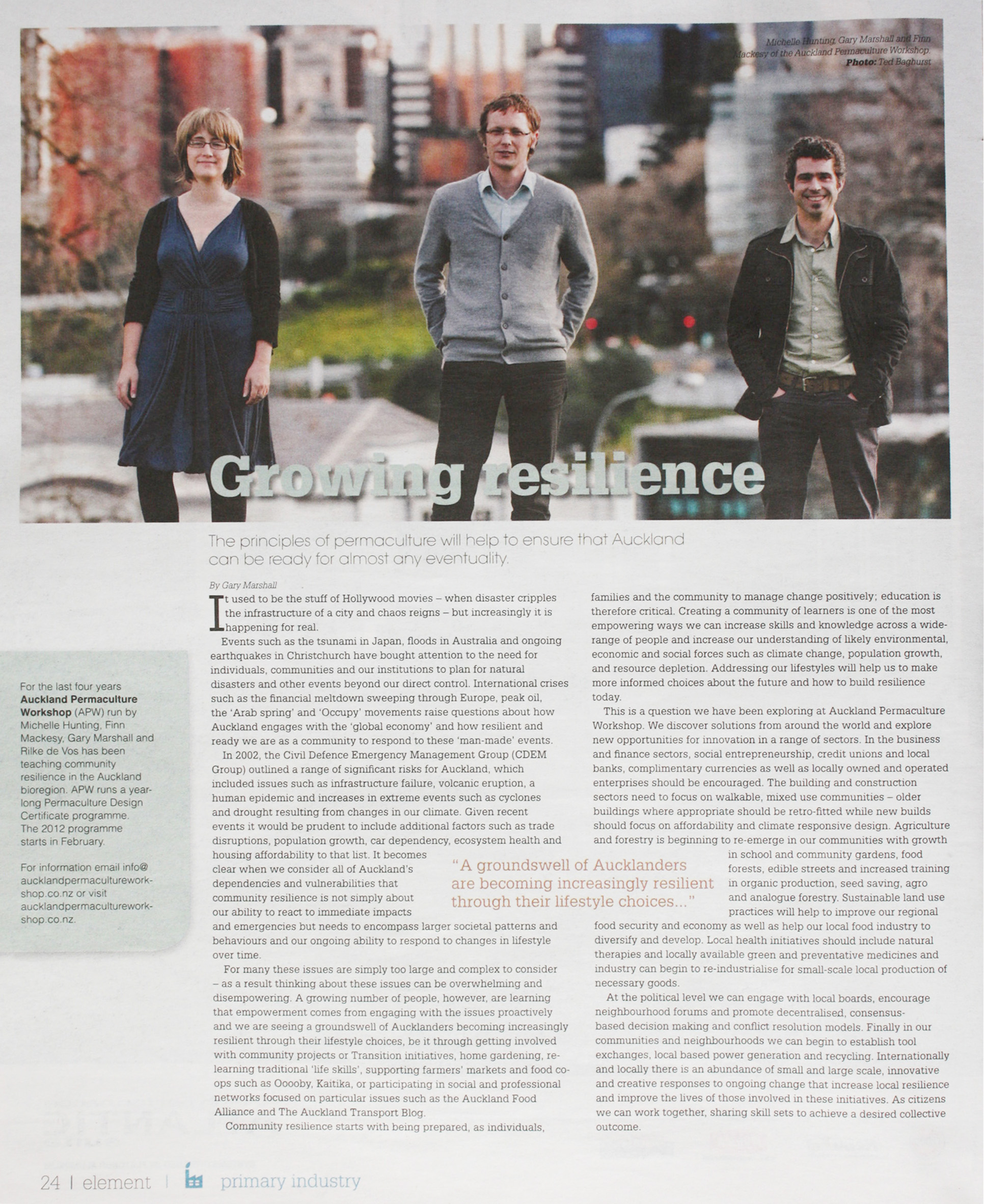
The principles of permaculture can help ensure that Tāmaki Makaurau, Auckland is ready for almost any eventuality. By Gary Marshall, 2012.
This article was originally published in Element Magazine in 2012 (a New Zealand Herald lift-out)*. While the events have changed, the broader pattern of disruption has continued, and the core message still holds: resilience isn’t just about climate change, it’s about designing and implementing practical, regenerative systems that support people, land, and community over the long term.
Through our new Foundation Programme, we’re expanding beyond Auckland to share our unique approach to permaculture education with communities across Aotearoa and beyond.
See our crowdfunding campaign here for information and to support the launch of our new Foundation Programme.
It used to be the stuff of Hollywood movies – when disaster cripples a city's infrastructure and chaos reigns – but increasingly, it is happening for real.
Events such as the tsunami in Japan, floods in Australia and ongoing earthquakes in Christchurch have brought attention to the need for individuals, communities and our institutions to plan for natural disasters and other events beyond our direct control. International crises such as the financial meltdowns sweeping through Europe, peak oil, the ‘Arab spring’ and ‘Occupy’ movements raise questions about how Auckland engages with the ‘global economy’ and how resilient and ready we are as a community to respond to these ‘man-made’ events.
In 2002, the Civil Defence Emergency Management Group (CDEM Group) outlined a range of significant risks for Auckland, including issues such as infrastructure failure, volcanic eruption, a human epidemic and increases in extreme events such as cyclones and drought resulting from changes in our climate. Given recent events, it would be prudent to include additional factors such as trade disruptions, population growth, car dependency, ecosystem health and housing affordability to that list.
It becomes clear when we consider all of Auckland’s dependencies and vulnerabilities that community resilience is not simply about our ability to respond to immediate impacts and emergencies but needs to encompass larger social patterns, behaviours and our ability to respond to changes in lifestyle over time.
For many, these issues are simply too large and complex to consider – as a result, thinking about them can be overwhelming and disempowering. A growing number of people, however, are learning that empowerment comes from engaging with the issues proactively. We are seeing a groundswell of Aucklanders becoming increasingly resilient through their lifestyle choices, be it through getting involved with community projects or Transition initiatives, home gardening, re-learning traditional ‘life skills’, supporting farmers’ markets and food co-ops such as Ooooby, Kaitaia, or participating in social and professional networks focused on particular issues such as the Auckland Food Alliance and the Auckland Transport Blog (now Greater Auckland).
Community resilience starts with being prepared, as individuals, families and the community to manage change positively; education is therefore critical. Creating a community of learners is one of the most empowering ways we can increase skills and knowledge across a wide-range of people and increase our understanding of likely environmental, economic and social forces such as climate change, population growth and resource depletion. Addressing our lifestyles will help us to make more informed choices about the future and how to build resilience today.
This is a question we have been exploring at Auckland Permaculture Workshop. We discover solutions from around the world and explore new opportunities for innovation in a range of sectors. In the business and finance sectors, social entrepreneurship, credit unions and local banks, complementary currencies, as well as locally owned and operated enterprises, should be encouraged. The building and construction sectors need to focus on walkable, mixed-use communities – older buildings where appropriate should be retrofitted, while new builds should focus on affordability and climate-responsive design. Agriculture and forestry are beginning to re-emerge in our communities with growth in school and community gardens, food forests, edible streets and increased training in organic production, seed saving, agro and analogue forestry. Sustainable land use practices will help to improve our regional food security and economy as well as help our local food industry to diversify and develop. Local health initiatives should include natural therapies and locally available green and preventative medicines, and industry can begin to re-industrialise for small-scale local production of necessary goods.
At a political level, we can engage with local boards, encourage neighbourhood forums and promote decentralised, consensus-based decision-making and conflict resolution models. From here, our communities and neighbourhoods can begin to establish local exchanges, locally based power generation and recycling. Internationally and locally, there is an abundance of small and large-scale, innovative and creative responses to ongoing change that increase local resilience and improve the lives of those involved in these initiatives. As citizens, we can work together, sharing skill sets to achieve a desired collective outcome.
* Minor edits have been made for readability; otherwise, the article is exactly as it appeared 14 years ago. term.